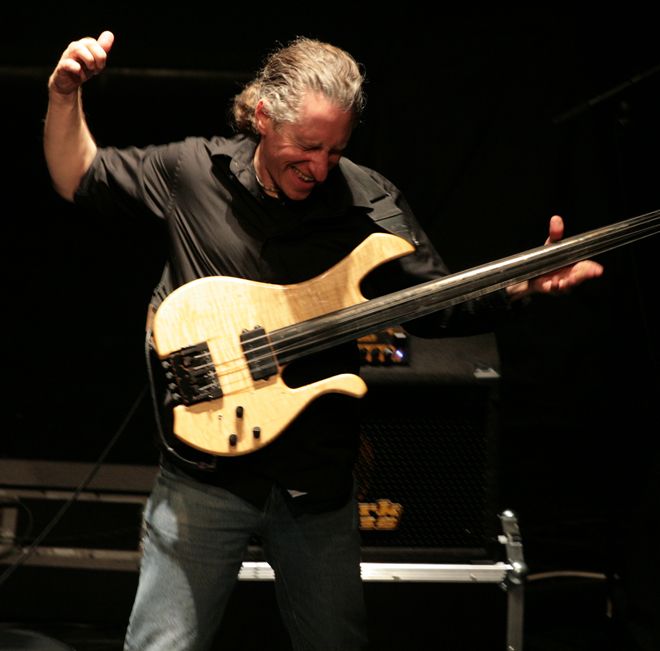
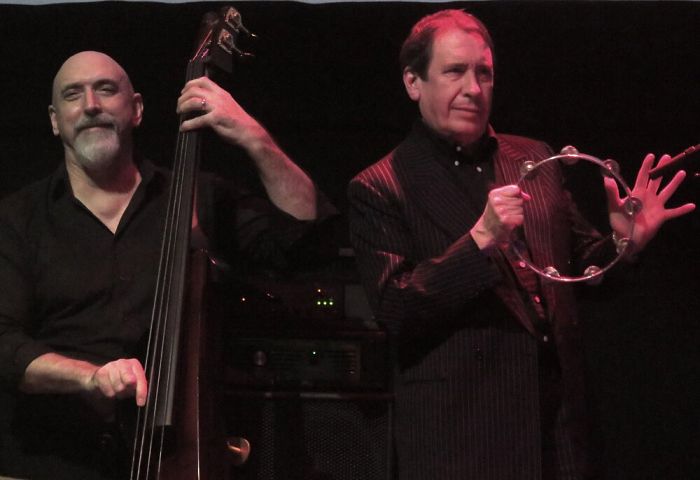
“If you twist my arm and ask me what type of music I play, it’s chamber music!” Fretless bass virtuoso, innovator and recording artist Michael Manring reflects on the evolution of “live” performance and the future of instrumental music outside of the mainstream. This clip is taken from an episode of The Bass Guitar Channel Radio Show with host David C. Gross and Know Your Bass Player “honcho” Tom Semioli.
“David, the electric bass is not a valid instrument…” David C. Gross and guest Michael Manring discuss their time at Berklee and the bold proclamation which forever affected Mr. Gross , how Manring straddles the “pre-Jaco and post-Jaco eras,” Michael’s tuning methodology, and how Joseph Zon helped bring Michael’s aural visions to fruition. This video clip is from a February 2021 episode of The Bass Guitar Channel Radio Show on Cygnus Radio, hosted by David C. Gross with Know Your Bass Player “honcho” Tom Semioli.
Jack Daley (Lenny Kravitz, Little Steven & The Disciples of Soul, Beyonce, Joss Stone)
Bassist Jack Daley (Lenny Kravitz, Beyonce, Little Steven & The Disciples of Soul, Joss Stone, Sara Bareilles, among many others) discusses his appearance with The Boss on SNL, his work as a bandmember and sideman, and his new Dug Deep recording studio in Asbury Park, New Jersey.
Writers/Interviewers: Tom Semioli, Mark Polott, and Joe Gagliardo. Editor: Mark Polott. Executive Producer: Mark Preston
He is a bass player you recognize in a single passage!
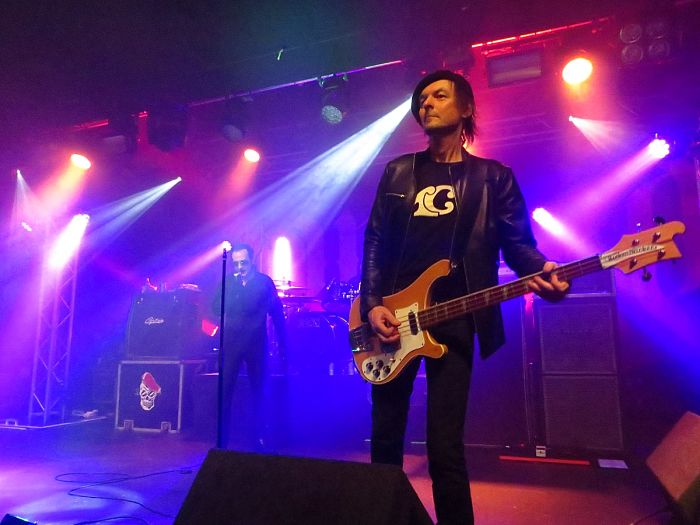
Renowned for his tenure in Eddie & The Hot Rods, The Damned, UFO, and his work with Johnny Thunders and Rob Tyner, among others, Paul Gray is the harmonic and rhythmic anchor of Professor & The Madman – an all-star collective featuring the diverse talents of singer / multi-instrumentalists Alfie Agnew (Adolescents, D.I.) and Sean Elliott (D.I., Mind Over Four); along with drummer Rat Scabies of The Damned. From lockdown in his home studio in Cardiff Wales, Paul discusses the latest PATM album Séance (November 2020), his storied history, Sensible Gray Cells, his love of Rickenbacker basses, and future plans – including remote recording and more.
Tom Semioli Writer / Interviewer. Mark Polott / editor. Mark Preston / Executive Producer. Props to Randy Haecker of Prime Mover Media!
A devotee of Jack Bruce, for whom he composed liner notes on a live release by the iconic bassist, Alan Lefton has been on the bandstand most of his life, and continues to evolve one gig at a time!
Alan on Know Your Bass Player on Film Season Deux, New York City, Euphoria Studios, 2018
Mark Polott (Haystacks Balboa, Urban Blue)
A dexterous finesse player, composer, multi-instrumentalist and yet another Queens, New York native who excels at his chosen instrument, Mark Polott has seen it all from the behind four strings: major label deals, tours with his rock mentors, club dates, sessions….
He is also the editor of Know Your Bass Player on Film! The anchor of Haystacks Balboa, Urban Blue, check out Mark’s Know Your Bass Player on Film Season Deux interview New York City 2019, New York City https://bit.ly/2FYXdpp
Joe Gagliardo (One of the Boyzz, Chuck Berry)
From his home in The Windy City, KYBP Chicago Bureau Chief recalls his performance with the “Father of Rock and Roll” – Charles Edward Anderson Berry! With Little Richard as the opening act, Chuck possibly mistakes Joe for Joey Spampinato who anchored Chuck and Keith Richards in the 1987 documentary Hail! Hail! Rock and Roll! upon Berry’s inspection of Gagliardo’s Danelectro – which was a nearly the same instrument used by the NRBQ bassist in the film.
Chris White (The Zombies)
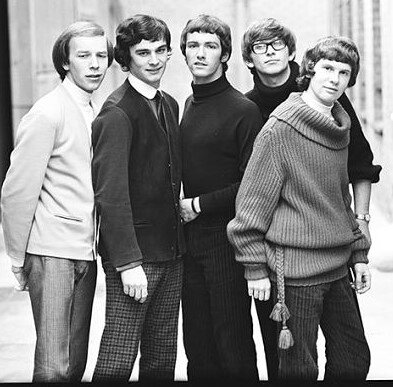
Former Zombies bassist Chris White holds the distinction of co-composing one of rock’s great masterworks Odessey and Oracle (1968). White, who reunites with the surviving original members for special anniversary performances of the aforementioned slab, is a dexterous pocket and counter-melodic player who, akin to his peer Sir Paul, takes a compositional approach to the instrument. Chris has collaborated regularly with his former bandmates Colin Blunstone and Rod Argent as a writer/producer, most notably co-composing Argent’s seminal hit “Hold Your Head Up,” which, as the late Zombies and former Argent bassist Jim Rodford noted in the Know Your Bass Player film series Season One, is founded on a bassline which Jim derived from an early Zombies hit.
“Oh I like that… The Zombies bass player!” The first time Chris White heard “She’s Not There” on broadcast media was on the BBC’s Juke Box Jury wherein guest panelist Beatle George Harrison praised the band and their bassist! The Zombies first recordings were helmed by a new kid in the studio who would go on to become a rock legend: Gus Dudgeon. From Terminal Studios in beautiful downtown Bermondsey UK, our first of a series of interview segments with producer / composer / bassist Chris White.
“It was like a cross between an ode and odyssey…” From Terminal Studios in beautiful downtown Bermondsey UK, our second in of a series of interview segments with producer / composer / bassist Chris White, who shares his recollections on one of the most iconic slabs in the history of rock and roll.
“I’m a songwriter who happens to play bass….”
In our third in a series of interviews with composer / bassist / producer Chris White from Terminal Studios in beautiful downtown Bermondsey UK, The Zombies bassist/composer (and Argent composer with Rod Argent) recalls writing “Hold Your Head Up” based on Jim Rodford’s permutated bassline from The Zombies classic “Time of the Season.” Following Chris’ interview, we include a clip from our 2014 Season One conversation at The Horn in St. Albans with the late Jim Rodford discussing the Argent hit and how he created the signature bass motif which inspired White and rocked a generation!
Mark Preston: “To have Chris White on film was very, very special to us, and to me on a deep personal level. I attended several moving performances of The Zombies Odessey and Oracle, including the historic 40th Anniversary show at Shepard’s Bush in 2008.
As we learn from our interview “A Butcher’s Tale” was composed by Chris, and it is an emotional recollection of how his family was affected in the Battle of Somme in World War One.
We conducted Chris interview on November 11 which is Armistice Day in England. Their holiday is similar to Memorial Day in the United States to honor fallen soldiers in past wars. Our cinematographer Derek Hanlon suggested that we post the Odessey and Oracle album on the wall behind Chris as visual backdrop. Before we started shooting our interview which was scheduled before noon, Chris asked me if we could pause for a moment of silence at the 11th hour of the 11th day of the 11th month to observe two minutes of silence as is custom.
Of course, we agreed. When the clock struck 11 in Room B at Terminal Studios in Bermondsey, we stopped shooting and all of us; including Bass Player editor Joel McIver, my partner Tom, Derek, Ollie our assistant, my wife Joanne, and Chris’ wife all stood in a circle with our heads bowed. Just seconds into our observance, the Odessey and Oracle album crashed to the floor. Chris opened his eyes and looked at me and I said “these things happen for a reason” and Chis said “yes they do…”
Here is our conversation with Chris!”
Kevan Frost (Boy George)
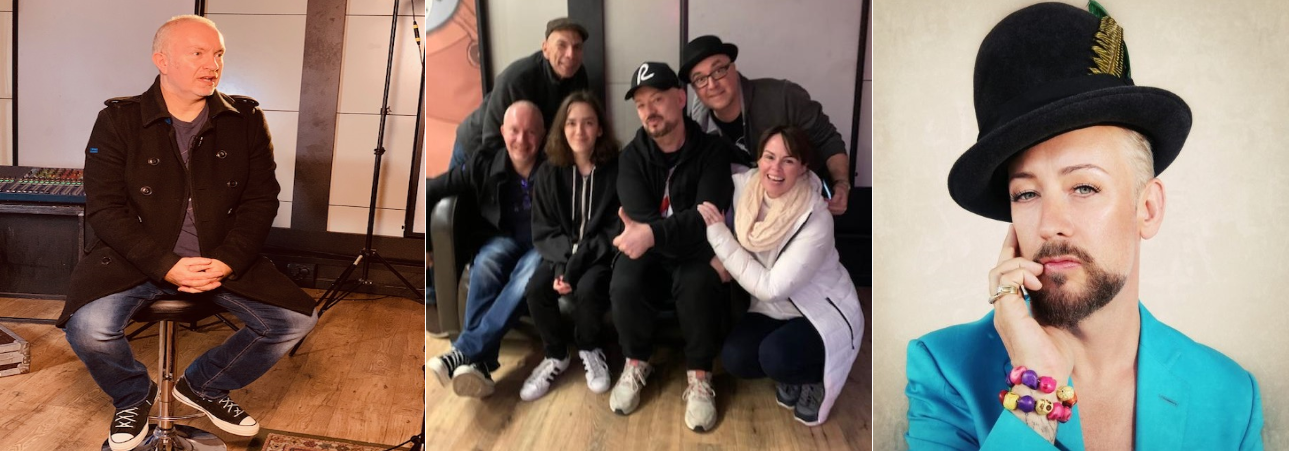
A multi-instrumentalist, producer, Tony Award / Drama Desk nominated composer (Boy George’s Taboo ) who was drawn to the bass by the work of Marcus Miller, Mark King, and Larry Graham… from Terminal Studios in beautiful downtown Bermondsey, London, Kevan Frost discusses his role as the former George O’Dowd’s anchor and musical director, and more!
Dave Swift (Jools Holland)
Courtesy of Dave Swift FB
Opines acclaimed author / editor / journalist / bassist Joel McIver “Dave Swift is one of the most, if not the most, recognizable bassists in England…”
From Terminal Studios in beautiful downtown Bermondsey, London, Dave Swift, known in his native land as the anchor of Later….with Jools Holland discusses his career and approach to the “craft” or is it “art” of playing bass! https://bit.ly/2YMv5fK
The Lonely Streets’ Warren Renfrow: What Becomes a Legend Most?
Rock and roll is in a tough spot, dear readers. The record biz is kaput. Terrestrial rock radio has gone underground i.e. it’s dead and buried. Sir Mick has a new valve. Punk rock relics are in museums and its fashion cues retail at Neiman Marcus. And alternative rock plays in Vegas. What next, Greta Van Fleetwood Mac?
But don’t lose faith, because just when it appears that our brickhouse has caved in, an album (that is, an assemblage of audio recordings issued as a collection on compact disc, vinyl, audio tape, or another medium) “drops” that restores our belief in three chords, a sunburst Fender Precision, and the truth (or something close to it).
Behold our saviors: Greg Antista and The Lonely Streets. Their debut disc – Shake, Stomp and Stumble sees the light of day on May 17, 2019 on Primal Beat Records. Their roots run deep, deep, deep into the Orange County / California punk scene.
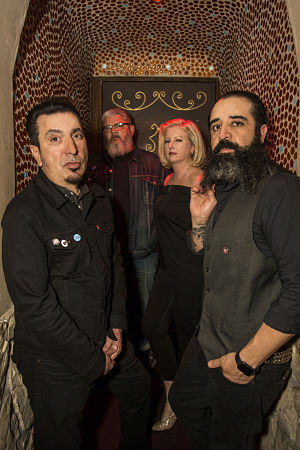
Kids in the Hall: LR Greg Antista, Warren Renfrow, Jessica Kaczmarck, Jorge E. Disguster
Where to begin? Bandleader / primary songwriter Greg Antista lists Joyride and Foxy on his resume. Lead-guitarist Jessica Kaczmarek toiled in Busstop Hurricanes, and Russell Scott & The Red Hots, among others. Jorge E. Disguster has manned the skins for Mr. Mirainga, Mink Daggers, Disguster and CoDependents.
And then there’s the star of the Know Your Bass Player show, bassist Warren Renfrow – anchor of the mighty Cadillac Tramps, Manic Hispanic, Final Conflict.
If you don’t like the way I play…move me! Bassist Warren Renfrow
If that does not impress you, you may be a Childish Gambino fan. Research these giants of their chosen genre on YouTube.
The band members have known each other for centuries (the press release reads “decades,” but you can never trust such documents) and despite the fact that they’ve been in business for a little over a year, these veteran cats rock with the exuberance of youth and the wisdom of age.
Thanks to digital and social media it is no longer required of a hack such as I to “describe” GAATLB music to you. I’ll draw analogies to Social Distortion, Alejandro Escovedo, Tom Clark and the High Action Boys, Jason & The Scorchers, The Clash, and The Stranglers – and I may be right. Antista is a master lyricist – akin to the best writers, he paints pictures with few words. The melodies are inescapable, and the rhythm section is air-tight, loud and proud.
Greg Antista assumes the position.
And what of our man Renfrow? We’re talking legend here. In addition to his aforementioned pedigree, Warren went to war as a touring bassist with The Damned and Adolescents.
Logistics and schedules prevented us from capturing Warren for Know Your Bass Player on Film – though Mark, Mark, Derek and I will see to it that we do.
Until then, we give you the words of Warren Renfrow.
Were the Renfrows a musical family? While I’m the only one in my family to play an instrument, I grew up in a household with seven siblings. I was exposed to everything they listened to — mostly ’60s pop/rock, with an emphasis on the Beatles and the Stones. My older brother was the closest in age to me. He took me to a lot of really great concerts like Elton John, AC/DC (with Bon Scott), The Who with Keith Moon, and one of the first tours by Elvis Costello and the Attractions.
At what point in your formative years did you gravitate towards playing a musical instrument? Like most kids, I air guitared with a stick or a broom. Then a family friend gave me a little Sears bass and amplifier (kinda wish I still had it). I remember sitting and trying to learn, playing along to side one of the first Rodney on the Roq album.
Describe the moment you first became aware of the bass – was it a record, a song you heard on the radio, a performance? It was probably listening to Dee Murray playing on “Funeral for a Friend/Love Lies Bleeding” from Elton John’s Goodbye Yellow Brick Road album. The sound, the tone…the way it pops out and drives the song.
How did you evolve into Warren the bass player? I saw an old, grainy VHS of the original lineup of The Damned performing. Captain Sensible was playing bass. He just had such an attitude, and that’s who I wanted to be. I even tried wearing a beret and little round glasses, but I’ve got too big of a noggin to carry off that look. Continuing with the Damned, another big influence was Paul Gray. Back in 2002, I had the opportunity to be the fill-in bassist for the Damned when they opened for a Rob Zombie tour. It was an awesome feeling playing those songs that I revered, and nailing it. Leading up to the tour, the drummer, Pinch, and I rehearsed in a garage, then drove straight through to Houston where the rest of the band met us. During our one rehearsal before the tour, I was so exhausted from the drive that it didn’t even hit me that I was playing with my idols. Going through the set, “Wait for the Blackout” came up. As we were playing that song, I looked up and saw Captain Sensible and Dave Vanian and that’s when it hit me. That very moment — out of everything I’ve done musically — remains the most memorable.
Many folks, despite their love of music, are woefully unaware of the existence of the electric bass and what it does. Anyone ever ask you “what does that thing do?” I’ve never had to answer for it. The bass and drums (the rhythm section) are the engine of the machine. The rhythm section drives the song. When you’re tapping your foot, or nodding your head, or dancing… it’s to the rhythm section. If you wanna be the star of the band though, bass ain’t for you. You’d probably get more attention if you were in the witness protection program. But if you’re an introvert, it’s the perfect instrument.
Tell me about your first gig – triumph or tragedy? I will say my first gig was pretty fuckin’ awesome. It was with my first band, The Inferior, with Ron Martinez, who I’d later play with again in Final Conflict. He’s now in the Lower Class Brats. I’m sure we sucked but we had the time of our lives.
The Cadillac Tramps were an iconic So-Cal ensemble: tell me about the recordings and performances you are most proud of. I loved the music on the first two albums but they weren’t recorded well. Those records failed to capture us properly as a live unit. By our third album, It’s Alright, we actually had a pretty good producer named Howard Benson, and the sound quality was a lot better. As far as performances and touring, I look at it as an evolutionary process. You need to build a fanbase. When you first visit a town it’s possible that you’ll only play to 10 people. A few months later that crowd would grow to around 50, then 100. If you visit that market consistently, you’ll eventually sell out the venue. Back then, during the early days of the Cadillac Tramps, it was all word of mouth. No internet. On the opposite end of the spectrum, I can remember taking the stage opening for Pearl Jam and hearing the roar of 12,000 people. I was overwhelmed. Tears welled up. As I reflect on that moment, I have to mention the Cadillac Tramps’ dynamic and talented frontman, Mike “Gabby” Gaborno. He was the guy who made everybody in the room feel like his best friend. He had that gift.
Recall for me the emotions you felt when you first heard yourself on the radio with Cadillac Tramps. It was on 95.5 KLOS, Uncle Joe Benson’s “Local Licks.” It was fuckin’ cool. You turned on the radio and there you were. I never thought that would happen.
The Tramps were/are a tremendous influence on a generation of alternative rockers – comment on the band’s legacy – what does that mean to you? It’s nice to hear we were influential, but honestly, I sure as hell didn’t know it. I haven’t given much thought to our legacy. I just look back on it as the best of times.
Final Conflict and Manic Hispanic also garnered acclaim aplenty – what was special about those ensembles? Final Conflict was special because it was my first real band. That band grew out of backyard parties, before we eventually played clubs. Now Manic Hispanic, that was special because it was a joke that took on a life of its own. Everybody in the band was of Mexican descent, so the twist was that we would take old classic punk songs and put our own cultural stamp on them. We would make them funny. It was a totally cool thing because we were all great friends and we’d get to goof out on these classic songs we loved, and laugh.
Tell me how Greg Anista recruited you to be one of The Lonely Streets. Back in the 1990s when the Tramps were at their apex, pretty much our favorite local band was Joyride with Steve Soto and Greg Antista. Steve and Greg shared singing and songwriting duties. I’ve always liked Greg’s songs. In between then and now, there were a lot of years where everyone settled down, had kids and kind of focused on that. Now everyone’s kids are older and getting out of the house. In 2017, Greg wanted to put a band together, and I believe it was Steve Soto who said, “Hey, why don’t you ask Warren to play with you.” Greg asked, and I’ve always loved his songs, so I said yeah and I’ve been having a blast ever since.
GAATLS are a group of friends and collective of rock and roll veterans – tell me how that affects the music – it sounds as if the band has been playing together for years! While I’m fortunate to have had the opportunity to play with many talented people, within the framework of a group, there’s a lot to be said for chemistry. When you like the people that you’re playing with, and you like the songs that you’re playing, it comes together quite easily. At this point in my life, I have to really like what I’m doing and have fun doing it, or it’s just not worth my time. I’m not going to play in a band just to play in a band.
Talk about recording SSS – did you work the songs out on the road first? The band certainly recreates the energy of a performance in the studio – not an easy thing to capture! Greg wrote all the songs acoustically and got together with us each individually, gave us his version, and then we all came up with our parts. The equation came together and gelled. Once again, a lot has to be said for chemistry. But if I would have to reveal our secret weapon, it would be Paul Miner at Buzz Bomb Studios. Paul is a great engineer and producer and he had a lot of great ideas during the sessions. I wish Paul was around when the Cadillac Tramps were recording.
SSS is a fantastic record – however we are living in a “post album” era. What are your opinions on the fact that the majority of music listeners stream single songs – is the album format dead? Is it relevant anymore? The album format was limited by how much music you could fit on two sides of a disc. Streaming music is the next evolutionary step. There are no limits to what people can create. I think the waters are still being navigated.
When you first picked up the bass, did you think you’d still be playing in your middle-age? It is more satisfying now as an experienced player as opposed to rocking in your younger ears? Early on, my only goal was to play parties, get fucked up, and get laid. Looking back on that now and where it’s taken me — and taking those goals into consideration — I have to say I am a major success. But it’s way more satisfying now. At the beginning I wasn’t part of the music. Now I am.
Recall for us your gig nightmare – that one show where everything that could go wrong went absolutely …wrong? There used to be these yearly shows called the Hootenanny. One year, the Stray Cats reunited to play the Hootenanny and the Cadillac Tramps were on the bill. I remember feeling really charged up and excited as we took the stage. Unbeknownst to us, our drummer had gotten really drunk in the lead up to our set. So instead of the Tramps hitting the stage like a wildcat, it was more like a beached whale. Horrible.
Who are some of your favorite bass players? Who were the players that inspired you even if you don’t play like they do? I guess I could bring up the usual suspects, like McCartney or Jamerson. There was a time that I really wanted to be and play like Paul Gray, but now as I’ve gotten older, I find myself being more of a ‘dug in, in the pocket’ groove rhythmic player. And I’m amazed by guys like Conrad Lozano or the Mighty Gil T or John Baz. You can’t teach the way those guys play.
Aside from The Lonely Streets – what more would you like to accomplish before you call it a career? Once again, I just want to have fun playing music that I like. As long as that’s happening, I’ll never call it a career and I’ll go into the box playing.
Breaking News: Warren has waxed a new slab with Manic Hispanic slated for summer release!